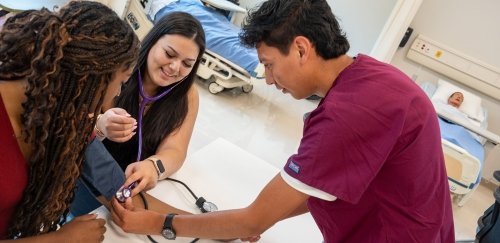
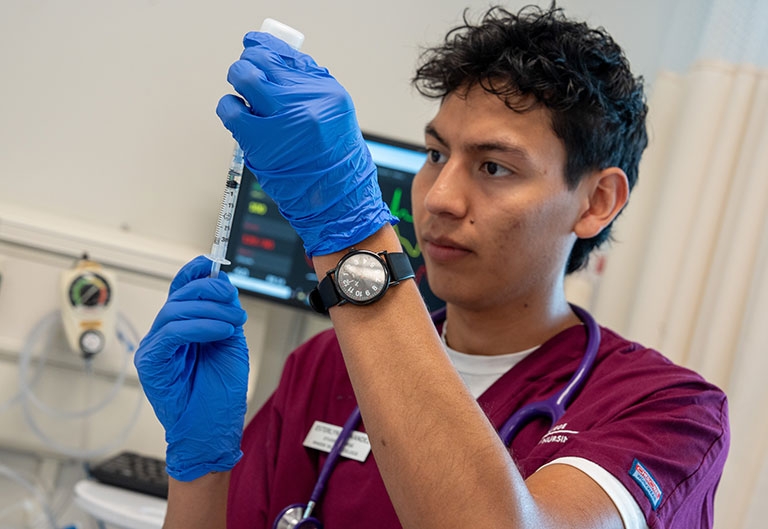
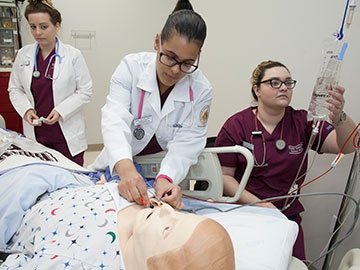
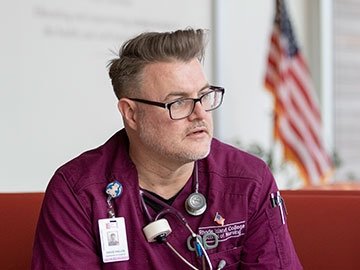
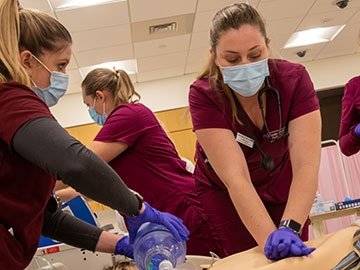
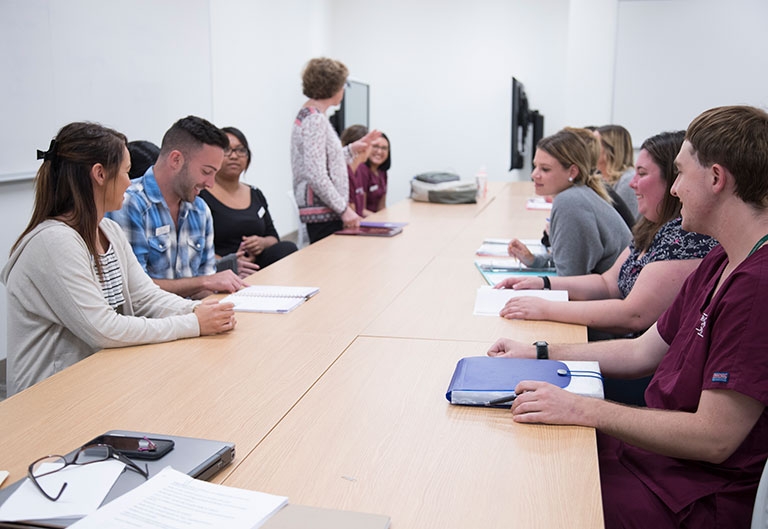
Nursing students going through nursing simulation scenarios and experiences.
Experience hands-on medical scenarios in realistic clinical environments.
Experience hands-on medical scenarios in realistic clinical environments.
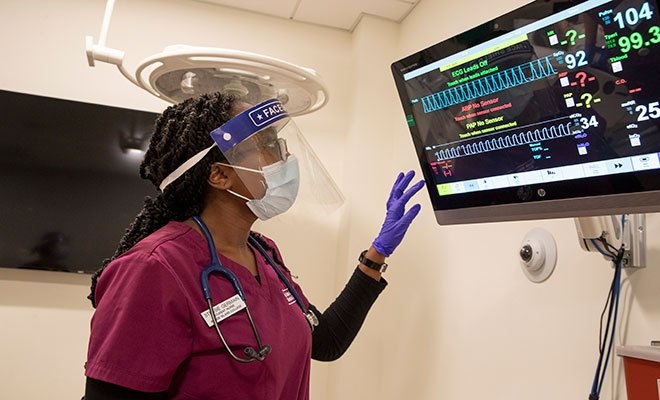
Our nursing simulation program provides students the opportunity to experience and respond to lifelike simulated medical situations.
How Does Nursing Simulation Work?
Students work with mannequins, computer simulations, and actors pretending to be patients in order to practice patient care skills, communication with patients and healthcare team members, ethics and professionalism, and quick thinking and practical decision making. This hands-on, realistic practice allows students to gain confidence, integrate classroom learning into real-world scenarios, and develop critical skills in a supportive, safe environment before caring for actual patients.
From communicating clearly and appropriately with patients and families to working effectively and properly with other members of the healthcare team, simulation scenarios solidify your verbal and non-verbal communication skills while ensuring that you're a natural team player. Part of this communication is documentation and charting of cases.
Ethics and Professionalism
All aspects of nursing simulation reinforce proper values for medical professionals. Respect for patients and other healthcare team members as whole-people with unique needs gets reinforced in an ongoing way. Students are taught to make considerate, ethical judgements and decisions while treating patients with compassion and maintaining confidentiality.
Critical Thinking and Decision-Making
In both routine and emergency situations it's essential to be calm, observant, analytical, decisive, and timely. Simulation situations provide you with the practice, space, and professional educator guidance to develop these cognitive skills. Through repetition and a variety of scenarios, you'll gain the confidence and experience to think clearly and respond appropriately.
Debriefing and Growth
Just as important as the simulations themselves are the conversations and learning that follow:
discussion of positive actions taken, challenges, and missed opportunities with faculty and fellow students
facilitating faculty hold certification in healthcare simulation (CHSE) and simulation educator designation (SED)
students reflect on and assess their simulation experiences, choices, and actions taken
State-of-the-Art Facilities
We're proud to say that all RIC nursing students benefit from simulated learning experiences.
Zvart Onanian School of Nursing
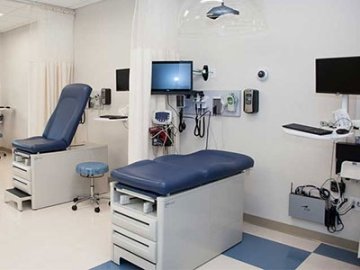
First and second year nursing students experience nursing simulation on our main campus, where we have a simulation lab for health assessment and fundamental skills training, as well as a human patient simulator lab, where life-like, anatomically correct, computer-driven mannequins with physiologic responses mimic real patients. There is also a control room with state-of-the-art equipment and computers that control the software system installed in the simulation rooms.
Junior and senior nursing students and graduate nursing students experience simulation at the Rhode Island Nursing Education Center (RINEC) in downtown Providence. RINEC is comprised of state-of-the-art classroom, lab, simulation and office spaces for both RIC and the University of Rhode Island.
Proudly Accredited
Our Nursing Simulation Program is accredited by the Society for Simulation in Healthcare (SSH), with our facilitating faculty being Certified Healthcare Simulation Educators (CHSE) and holding Simulation Educator Designation (SED). Get more details on our nursing simulation accreditation.
Experience Nursing Simulation in Our Nursing Programs
We'd be happy to provide you with additional information on any of our nursing programs.
An undergraduate nursing program, our Bachelor of Science in Nursing, that makes you eligible to apply to take the NCLEX-RN examination for licensure as a registered nurse in any state.
Our Master of Science in Nursing degree, for those with a BSN and an active registered nurse license who are seeking advanced studies in high-demand specialties or who are preparing to take the next step in their careers.