
High-Demand Nursing Careers
- Long-Term Care / Gerontology Nurse
- Emergency Department Nurse
- Critical Care Nurse
- Pediatric Nurse
- Maternity Nurse
- Psychiatric Nurse
- Nurse Manager
- Community Health Nurse
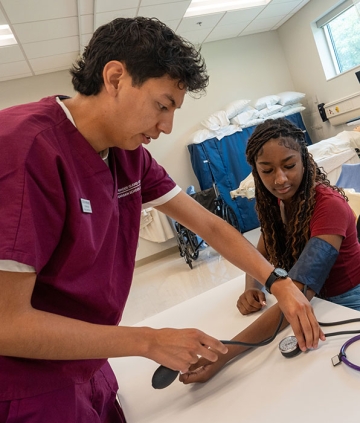
With a rigorous academic foundation and clinical placements that provide vital experiential learning opportunities, our nationally recognized Bachelor of Science in Nursing prepares students for a rewarding career. Graduates are eligible to apply to take the NCLEX-RN examination for licensure as a registered nurse in any state.
One Day Only! Join students from across Rhode Island on November 16 and apply free to Rhode Island College! Take advantage of Apply to RIC for Free Day and we'll waive your $50 application fee.
On November 7, from 12:30–4 pm, come see all that RIC has to offer. Discover how we prepare students for success through in-demand academic programs, hands-on learning and state-of-the-art facilities.
We're thrilled that you're interested in Rhode Island College and we want to make sure that nothing stands in your way of pursuing a RIC degree. Just let us know how we can help you with your next steps.

Understand the courses you’ll take, the curriculum requirements to meet, and the concepts you’ll gain mastery of. We also offer a specifically-outlined Second Bachelor’s Degree Option for this program. Get all the detailed information you’re looking for.
The BSN, MSN and DNP programs at Rhode Island College are accredited by the Commission on Collegiate Nursing Education and our Nursing Simulation Program is accredited by the Society for Simulation in Healthcare (SSH).
If you you plan to work outside RI and need licensure in another state, you may be required to submit a Certificate of Graduation—and we’re here to help! BSN graduates simply email McKenzie Saunders in the School of Nursing with their full name (including any name(s) used while enrolled at RIC), date of birth, and details of any clinical placements completed outside of RI.
Processing times vary, but we'll get you your certificate as quick as possible.
We have 30+ full-time faculty teaching in the Zvart Onanian School of Nursing, each with a master's degree in a nursing specialty. 20+ Zvart Onanian School of Nursing faculty are doctorally prepared, and many hold national certifications.























“RIC’s School of Nursing has some of the most dedicated, passionate and driven faculty and staff anywhere. When I say that they changed my life, they truly did.”

Rhode Island College School of Nursing — a regional leader in innovation and simulation.
Every year students must provide health services with evidence of a negative PPD test or compliance with treatment. Before beginning some clinical nursing courses, students may be expected to meet additional health requirements. All nursing students must have the following information on file with RIC's Office of Health Services in Browne Hall.
*Health-care workers born on or before Dec. 31, 1956, are only required to have documentation of one dose each of measles, mumps and rubella or titers confirming immunity.
**2-Step PPD – two separate PPDs planted at least a week apart but not more than a year apart prior to entering into nursing clinical.
Students will not be admitted to the first class meeting of a nursing practicum course without having complied with the health requirements. Proof of immunization may be obtained from your physician, high school, previous college or university, military record and/or from blood titers.
Please Note: Religious exemptions are not accepted due to the need to meet requirements of our clinical agencies.
Nursing majors should follow the guidelines on the college immunization form or call RIC's Office of Health Services at 401-456-8055 for further information. Once all required information is complete, students may pick up their laminated identification cards at RIC's Office of Health Services in Browne Hall.
Our Bachelor of Science in Nursing program is what's commonly known as a Basic Baccalaureate Program or Basic BSN – the standard Nursing program designed for high school graduates and transfer students to complete in four years. This program integrates knowledge of the arts and sciences with nursing theory to prepare you to practice as a Registered Nurse (RN). The three major elements of the nursing curriculum are general education courses, courses related to nursing, and required nursing courses.
Students must consult with their advisor each semester before registering for courses.
| Course Number | Course Title | Course Credits |
|---|---|---|
| BIO 201/202 | Anatomy & Physiology | 4 |
| FYS or FYW | First Year Seminar or First Year Writing | 4 |
| PSYC 110 | Introduction to Psych | 4 |
| Math | 4 | |
| NURS 100 or RIC 100 | Nursing 100 or RIC 100 | 2 or 1 |
| Total: 18 |
| Course Number | Course Title | Course Credits |
|---|---|---|
| BIO 203/204 | Anatomy & Physiology II | 4 |
| FYS or FYW | First Year Seminar or First Year Writing | 4 |
| PSYC 230 | Human Development | 4 |
| CHEM 121 | Chemistry Fundamentals for Healthcare | 4 |
| Total: 16 |
| Course Number | Course Title | Course Credits |
|---|---|---|
| N230 | Health Promotion & Disease Prevention | 3 |
| BIO 348 | Microbiology | 4 |
| N231 | Pathopharmacology | 4 |
| Gen Ed | Gen Ed | 4 |
| Total: 15 |
| Course Number | Course Title | Course Credits |
|---|---|---|
| N232 | Health Assessment of Diverse Populations | 3 |
| N233 | Essentials of Nursing Knowledge and Practice | 6 |
| N234W | Scholarly Inquiry and Informatics (WID) | 3 |
| Gen Ed | Gen Ed | 4 |
| Total: 16 |
| Course Number | Course Title | Course Credits |
|---|---|---|
| N351 | Adult Nursing Care of Common Conditions | 6 |
| N352 | Patient Centered Psychiatric Mental Health Nursing | 6 |
| Gen Ed | Gen Ed | 4 |
| Total: 16 |
| Course Number | Course Title | Course Credits |
|---|---|---|
| N353 | Adult Nursing Care of Complex Conditions | 6 |
| N354 | Innovative Leadership | 3 |
| Gen Ed | Gen Ed | 4 |
| Total: 13 |
| Course Number | Course Title | Course Credits |
|---|---|---|
| N381 | Family-Centered Care in Pediatric Nursing | 6 |
| N382 | Maternal Newborn Nursing | 6 |
| Elective | Elective | 2 |
| Total: 14 |
| Course Number | Course Title | Course Credits |
|---|---|---|
| N383 | Global, Community and Public Policy | 6 |
| N384 | Nursing Practice Synthesis | 6 |
| Total: 12 |
Total Credits for All Semesters: 120
Upon completion of this program, students will be able to:
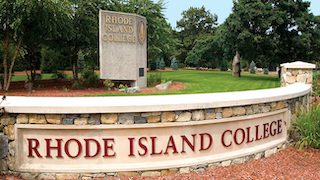
From the Bachelor of Science in Nursing to the Doctor of Nursing Practice, the Rhode Island College Zvart Onanian School of Nursing educates and prepares graduates for the challenges of today’s complex health care settings.