
High-Demand Communication Careers
- Advertising Executive
- Social Media Influencer
- Digital Marketing Specialist
- Videographer
- Podcaster
- Broadcast Journalist

Nearly every major company or industry employs communication professionals in some capacity. RIC's Communication Program provides practical, real-world education in some of the most important disciplines in the field. Our Communication BA combines hands-on media experience, industry-focused coursework, and flexible career pathways to prepare students for success in today’s evolving communication landscape.
One Day Only! Join students from across Rhode Island on November 16 and apply free to Rhode Island College! Take advantage of Apply to RIC for Free Day and we'll waive your $50 application fee.
On November 7, from 12:30–4 pm, come see all that RIC has to offer. Discover how we prepare students for success through in-demand academic programs, hands-on learning and state-of-the-art facilities.
We're thrilled that you're interested in Rhode Island College and we want to make sure that nothing stands in your way of pursuing a RIC degree. Just let us know how we can help you with your next steps.

Understand the courses you’ll take, the curriculum requirements to meet, and the concepts you’ll gain mastery of.
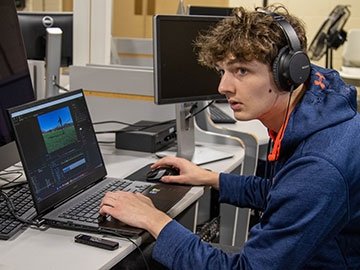
Get prepared for a career in the media (TV, video, podcasting/radio, streaming, social, journalism, sports, entertainment and digital) and advertising (marketing communications) industries.

Understand how humans create and interpret speech and language and how they hear sounds. Gain the necessary foundation to pursue speech-language pathology or audiology at the gradate level.
Communication students learn by doing, with project-based courses and real-world opportunities to build a portfolio of work to present to future employers and graduate schools.
Communication students benefit from expert-led classes and hands-on internship opportunities in a flexible program that supports students’ individual backgrounds, needs, and interests.









“The real-world experience I had at RIC was huge, whether it was having my own political talk show [“Capitol Hill”] on RIC’s radio station or writing for the Anchor newspaper or working in student government.”

There are few students who have done more to realize their dreams than Baccari.

Jonathan Robinson is among the top 10 ticket salesmen in the NBA.
The BA in communication has you choose a concentration in Media Communication and Advertising or Speech, Language, and Hearing Science.
The Media Communication and Advertising concentration prepares students for careers in the media (TV, video, podcasting/radio, streaming, social, journalism, sports, entertainment and digital) and advertising (marketing communications) industries. With the help of an expert faculty advisor, students can focus their studies on media, advertising or some combination of these two growing and complementary fields. Students are encouraged to make use of the on-campus multimedia production studio and computer lab and join student-run organizations, such as The Anchor (the student newspaper), ANCHOR TV and WXIN (the RIC radio station). Internships with local media outlets/departments or marketing communications agencies are encouraged. For more information contact Brian Knoth, Ph.D.
The BA in communication has you choose a concentration in Media Communication and Advertising or Speech, Language, and Hearing Science.
The Speech, Language, and Hearing Science concentration gives students a basic understanding of speech, language, and hearing. Our curriculum covers the core courses considered by the American Speech-Language-Hearing Association (ASHA) to be prerequisites for graduate study. While an advanced degree in speech-language pathology or audiology is required by ASHA, our program offers students the necessary background for graduate study. Many of our students go on to pursue advanced degrees.
Please Note: Some careers require advanced degrees.
Upon completion of this program, students will be able to:
Upon completion of this program, students will be able to:
Declaring a minor allows you to explore other areas of interest and make interdisciplinary connections. Minor areas at RIC complement and reinforce all major areas of study. By declaring a minor, you can set yourself apart as a candidate for job, internship and volunteer opportunities. Many major programs at RIC offer a corresponding minor program, intended for students from other majors. Some programs also offer specialized minors, which work well for all students
Students interested in communication who do not wish to major in it should consider our minor program. Take a closer look!
Communication Minor Course Requirements
The minor in digital media production is a specialized minor, meant for any student who wants to expand their digital media skills and learn to produce professional audio, video, music, podcasts, live streams and other multimedia projects. Courses in the minor provide students with foundations in concept development and scriptwriting for various forms of media and opportunities for advanced study in video and audio production and other forms of multimedia content creation. The digital media minor provides skills that complement a wide variety of majors, including education, psychology, music, theatre and dance.
Our mission is to prepare students to communicate effectively as professionals and citizens in our state, nation and the world.