Career Ready

“Our goal is to make RIC a place where students can link their academic studies with a career right from day one.” – President Jack R. Warner
Rhode Island College has made it an institutional priority to ensure that graduates leave here career-ready – and to start that process earlier than ever. Students aren’t waiting until junior or senior year to consult a career counselor. They’re starting as soon as they enroll.
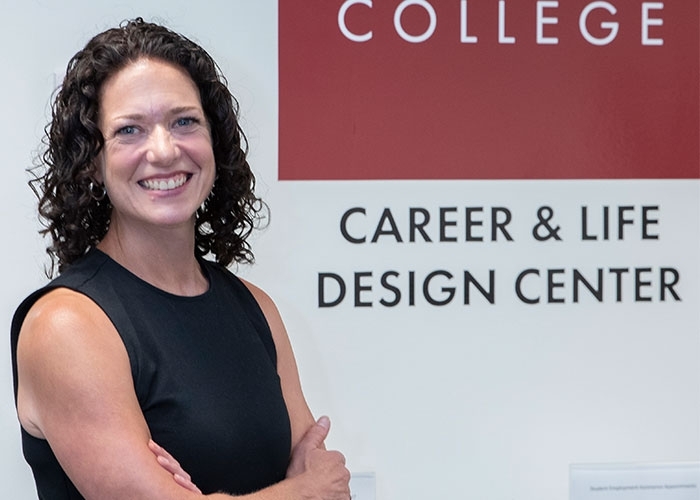
To that end, the college’s former Career Development Center was rebranded this past fall. It was given a new name, the Career & Life Design Center; a new director, Thea Cerio; a new assistant director, Jacky Pseekos; and three new career specialists – the first in the history of the college.
Career specialists are boots-on-the-ground counselors, meeting freshmen at Open House, First Year Orientation and Transfer Student Orientation; they’re partnering with academic advisors, who are sending undeclared majors or any student with a career-related question their way; they’re acting as liaisons for the five schools and have set up offices in each school; and they’re reaching out to faculty to present in their classrooms on career-related topics.
This is all part of the college’s dedicated effort to ensure that RIC students not only leave with a degree but leave ready to step into a career.
“The president’s vision is very much at the heart of our work at the Career & Life Design Center,” says Cerio. “We want students to see career development not as something that happens at the end of their college experience, but as an ongoing process that begins as soon as they arrive on campus.”
The Age-Old Question
By the time we start grade school, well-meaning adults are already asking us, “What do you want to be when you grow up?” For a child, the answer is easy: “I’m going to be a doctor, a fireman AND a policeman.” By the time they reach college, they still have no idea.
“Very few people take a linear path to their career,” says Cerio, who hails from Dean College, where she was director of Career Planning & Internships. That’s why Rhode Island College has incorporated a powerful new approach to career guidance called “life design.”
The life design model helps students build a career that aligns with their values, interests and overall life goals, rather than following a single, linear path. A key principle of life design is exploration – students are encouraged to explore multiple career possibilities through hands-on experimentation while including the whole self in that exploration. That means making sure their future career aligns with what they consider to be a meaningful life, not just professional success.
RIC career specialists Jeff Pini, Cindy Polanco and V Kelley were hired to guide students through that process. Each counselor has been assigned to a specific school(s) at the college; however, they also work with any student regardless of major, including those whose major is undecided.
Polanco is liaison for the School of Business; Kelley is liaison for the nursing, social work and education schools; and Pini is liaison for the Faculty of Arts and Sciences.
Explore Who You Are
“If you’re undecided about a career,” says Pini, “the first step is to explore your interests.”

One of the ways he and his colleagues help students explore is through online assessment tools. The Work Interests Assessment tool is one resource that presents 36 different work scenarios. On a scale of “Not at All Interested” to “Very Interested,” students rate their interest in each work scenario. Based on their responses, the tool suggests occupations that connect with their interests. It also lists supporting majors that might help them get there.

Students who’ve already decided on a major may not be aware of all the career paths they can take. A career specialist can show them their options.
“A social work major, for instance, can do many things with their degree that they might not be aware of,” says Kelley. “Did you know there’s an area of social work called veterinary social work? How about occupational social work?” Kelley uses an online tool called What Can I Do With This Major? to help students explore.
“This tool takes an occupation like social work and breaks it down into subcategories, such as health, criminal justice and community service,” she says. “All of these subcategories provide detailed information about the occupations in those areas, the types of organizations to look for when searching for a job and the skill sets and education required.”
RIC alumni who are interested in exploring new career paths, are encouraged to use this resource, as well.
“I wish I had started exploring careers earlier on as a freshman,” says junior Elizabeth Turbi. “When I started at RIC, I thought I wanted to go into pre-med, but last summer I did a four-week summer enrichment program called Month of Medicine at Brown University and realized that the medical field was not for me. If I had had that experience earlier on as a freshman, I would have saved a lot of time and energy. I also probably missed a lot of opportunities.
“I’m not sure exactly what I want to do, but I want it to involve ecology. I took an ecology class last semester with Dr. Hewins and loved it. I love being outdoors, I love animals and the environment. Right now, I’m applying for a research opportunity with him in the summer and I hope to go on to graduate school.”
Exploring Jobs & Internships
The Career & Life Design Center encourages students to explore future careers by applying for internships, volunteer opportunities, job shadowing, part-time jobs and on-campus extracurricular activities related to their interests. These experiences give them a chance to test drive a career before they’re fully committed.
As assistant director, Pseekos is responsible for creating and sustaining partnerships with employers who are looking to recruit students and alumni for jobs and internships.

“We use an online job portal called Handshake, where employers post their positions and where students and alumni can access them,” she says. It contains on and off-campus jobs; full- and part-time work; paid and unpaid internship opportunities; and work study and non-work study jobs.
What’s more, alumni have access to Handshake, too. As long as their account stays active and up to date, they’ll learn about opportunities as soon as they’re posted and be invited to participate in job and internship fairs.

“We display our upcoming career fairs, workshops and recruitment tables both on Handshake and on riconnect.ric.edu – our campus-wide event posting platform,” says Pseekos. “This fall I created employer recruitment tables so that any employer who couldn’t attend a career fair could book a table from 12-2 p.m. at Donovan Dining Center.”
Pseekos orchestrates the All Majors Job and Internship Fair in March, the Education Job and Internship Fair in April and the Grad School Fair in the fall. She also helps plan the fall School of Business Job and Internship Fair.
Students need all four years to explore their interests and to discover different paths that might be best for them, says Cerio. “Exploring and testing potential career paths allows them to make more informed decisions, build confidence and graduate with both direction and experience.”
Job-Readiness Skills
All three specialists teach job-readiness skills through one-on-one counseling sessions, workshops and in-class presentations in faculty classrooms. These strategies help students position themselves competitively.
They learn how to tailor a résumé and cover letter, how to improve interview skills, how to create a LinkedIn profile and Portfolium, how to collect references from faculty and previous employers, how to research companies and their work environments and how to develop a professional network.

RIC junior Connor O’Neill, a triple major in political science, public administration and public policy, landed a paid internship with Sen. Jack Reed last summer.
“I worked locally with the senator in his Cranston office for three months,” he says. “If I had been aware of career services earlier, it would have been a pretty significant help for me in writing my resume for that internship, because when I brought my resume to career counselor Jeff Pini, he gave me a lot of suggestions for improving it. He made sure I included just the right amount of information about my past work and internship experiences. He made sure I had the proper courses listed. I didn’t know coursework could be included on a resume, but he showed me how to include anything of relevance.”
Though O’Neill already has impressive volunteer and internship experience – along with interning for the senator, he was appointed to his town’s planning board when he was just a freshman – he says, “Even if you think you don’t have enough relevant experience, the career counselors are there to nudge you in the right direction and show you what doors to open and what places to apply to and how to build out your resume and experiences so that you can be ready for your first internship or first job. I found it to be a warm and welcoming environment.”
Like O’Neill, Kiara Romba, a junior double majoring in strategic communication and data analytics, sought out career services for help with her resume.

I wanted to apply for a job on campus,” she says. “Though I’ve had a lot of experiences, I didn’t know how to put my resume together. I was putting things down on paper, but I didn’t know what mattered most or what would motivate an employer to hire me. I am originally from the Ivory Coast in West Africa, a French-speaking country. The way we structure resumes is different than here. I made an appointment with career counselor V. What I liked most is that she explained to me in detail how and why I should phrase things in a certain way.
“I was also very shy about my accomplishments. For example, I was class president in my country, but I didn’t think it was important to note it on my resume because it’s an experience that happened outside of this country. V said, ‘Yes put it in. For a communication major, it’s important for your employer to see that you have experience leading people.’
“I also didn’t think it was important to mention the fact that I’m bilingual. V said, ‘You speak French and English. Put it in your resume.’ She was very encouraging. In another session, she explained to me how to do a mock interview. I practiced at home with ChatGPT. It asked me questions and I prepared for the interview. Ultimately, I got the on-campus job, and I love it. Now I feel more confident.
“I’ve been back to the career center five or six times now. I’ve worked with both Jeff, who helped me with my LinkedIn account, and V who helped me with my resume, cover letter and my interview prep. I know I will continue to come back because every new step in my experience requires an adjustment in my resume.”
Turbi’s resume was targeted for summer biology research. “Rather than copy sample resumes and templates online, I think it’s better if you have a career counselor help you craft your resume based on the experiences you have,” she says.

“Jeff had me go over my past work experiences and extracurricular activities and list my responsibilities,” says Turbi. “We crafted bullet points together, highlighting the skills I have that are relevant to research. By the end of the session, my resume was pretty structured. I feel great about it, and it has allowed me to submit my research application.”
“There’s a lot of resources for us on campus that we’re paying for that we don’t take advantage of, such as the Career & Life Design Center,” says Romba. “Other people can be a resource to help us move forward. They’ve already paved the road to make it easier, why not take it?”
An Alumna’s Job Search

Mia Hammond, a management major, met with career specialist Polanco at the start of her last semester at RIC. She has since graduated. When they met, Hammond wanted to figure out a plan for how to use her management degree.
“I was definitely feeling a lot of pressure during that last semester,” Hammond admits. “People used to say, ‘Oh, you have all four years to figure things out.’ But those four years go by fast and I still hadn’t figured it out. I was freaking out a little bit.”
Hammond used to work as a server in a restaurant, but there had been a fire and the restaurant had to let everyone go. Hammond’s idea was to apply as a server at another restaurant. But Polanco suggested that this would be a good opportunity for her to apply for a restaurant management position since she already knew the industry and enjoyed working in it.
“I thought I was underqualified for a management position,” says Hammond, “but Cindy saw skills in me that I hadn’t thought about.”
“In her mind, she was just a server, but I saw a lot of transferable skills – multitasking, time management, working under pressure, interpersonal skills, training new servers, which is a leadership skill, and much more,” says Polanco. “We upgraded her resume with those skills in mind and it gave her enough confidence to apply for a restaurant management position.
“I also gave her some interviewing tips, and we went over her cover letter, where she was able to elaborate not only on her restaurant experience but on the college courses she’s taken that she can apply to her job. She not only has the experience, she has the degree – two things working for her.”
“From that resume and cover letter, I got interviews for professional positions that I wouldn’t have been able to with my previous resume,” Hammond says. “It was exciting. Cindy also explained to me that even though I’m not a student anymore, I can still come back to the center anytime I need to. Here I had been thinking, ‘Whoa, I’m going out into the real world and I’m on my own.’ It made me feel better to know that I’m not alone, that I have all these resources from Rhode Island College that can help me. It’s good to know that it’s a ‘forever’ kind of place.”
Go For It
“It’s never too late to use career services. We’re here to help,” says Cerio. “Our career specialists are integrating into every aspect of campus life. They’re leading workshops, providing one-on-one counseling sessions, presenting in classrooms, guiding students through the life design model, helping them explore possibilities and helping them determine which career path is going to fulfill them. We want to make sure that the entire campus knows who we are and what we do and to send students our way.
“Ultimately, our goal is to ensure that every student understands how their RIC education translates into meaningful next steps and feels supported in designing a life and a career that aligns with who they are and where they want to go – starting from day one.”
The Career & Life Design Center facilitates undergraduate, graduate and alumni career exploration. Students and alumni may make an appointment with a career specialist at RIC’s Career & Life Design Center by calling (401) 456-8031. Current undergraduate students may also schedule an appointment on Starfish, while grad students and alumni use Handshake.