
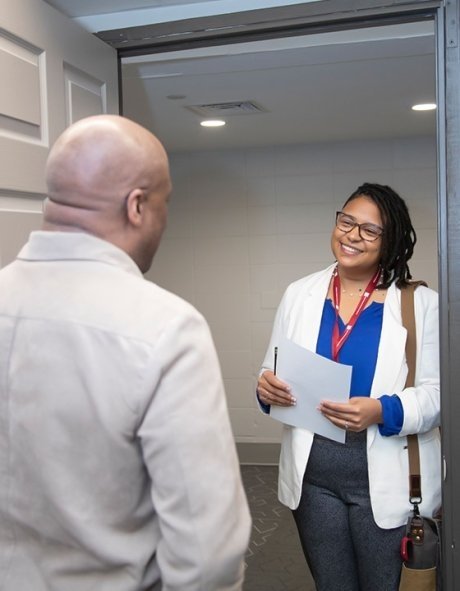
This lab will train students on best practices when they enter a client’s home.
Inside RIC’s School of Social Work, students are starting to abide by the adage “practice makes perfect” in a new simulation lab.
“Social work is an applied science,” says Dean Samuel Terrazas. “Students who leave our program must demonstrate competency, and one of the best ways to teach them about competency is through a simulation lab.”
Simulation labs are immersive, high-fidelity training environments where students and professionals practice clinical skills using actors in realistic scenarios, such as home visits or office interviews.
Terrazas says to be successful, a social worker must master nine competencies some of which include demonstrating ethical and professional behavior, advancing human rights and intervening with individuals, families, groups, organizations and communities.
Located on the school’s lower level, the lab features a television, furniture, cabinets, household appliances and a door – all of which are meant to mimic a scenario professional social workers may encounter.
“With this door, the idea is to train students to think about what they’re going to do the moment they enter a house,” Terrazas says. “They can practice the skills they will apply, such as not being biased about the way a house looks.”
In his decades of experience as a social work practitioner, Terrazas says he’s witnessed how simulation labs successfully instill confidence in students.
“In many cases, these lab experiences have helped students stick with studying social work,” Terrazas says. “Yes, the lab can be intimidating, but if done correctly, after a while, students get comfortable quickly and see the value in it.”
Terrazas likened lab work to practicing basketball.
“How do you become a good basketball player. It’s not going to involve writing papers about it. It’s not going to involve quizzes on it. It requires being on the court, falling down and getting elbowed. It’s the same with social work. You have tenuous moments, but you work through them,” he says.
Every social work student will use the lab.
“We want freshmen and sophomores to be exposed to the lab early on,” Terrazas says. “They may observe their peers during a simulation or act as a client. My hope is that the more students engage in simulations, the less intimidating it will be. However, a freshman simulation is going to be different and less complex than that of a master’s student.”
The lab aligns well with the Council on Social Work Education standards, he says.
“Some of the standards require that in our assessments we demonstrate how students practice behavioral methods. It’s not that we can’t assess things in other ways, but having a lab is the most direct way in which students can demonstrate this,” says Terrazas.
The lab is also equipped with audio/video technology.
“What we’re hoping to do is create a repository of videos that can serve as examples for our students to learn from,” he says.
RIC Assistant Professor of Social Work Vilna Tejeda says the lab is an asset to the school.
“I have witnessed firsthand how powerful simulation can be in strengthening learning and improving practice readiness,” says Tejeda, who, as director of interprofessional education at the Rhode Island Nursing Education Center, has taught in the nursing simulation labs. “Having our own dedicated simulation lab will allow us to tailor scenarios specifically to social work competencies, deepen the integration of theory and practice and expand the frequency and variety of simulation experiences available to our students.”
Learn more about RIC’s School of Social Work.