RIC Means Business
Within the last four years, student enrollment at RIC’s School of Business has grown from 900 to 1,300 students, an increase of more than 40 percent. This makes it second only to the Faculty of Arts and Sciences in terms of enrollment among the college’s five schools.
That increase represents only one aspect of the growth happening in a school bustling with three new majors (sports management, cybersecurity and AI), more than 150 partnerships with local businesses and new cybersecurity facilities – with plans already in the works to add more.
When Marianne Raimondo became dean in 2022, she said one of her top priorities was to connect students with the business world beyond RIC.

As she steps down to take on the new role of vice president for academic affairs at the Community College of Rhode Island, she takes stock of the School of Business’s progress: “I’m gratified that many of the strategies that the faculty and I worked on are bolstering student support, developing professional competencies and connecting them to internships and jobs.”
Sports Management
Rhode Island College became the first college in the state to offer a formal sports management major in the fall of 2023. It is one of the fastest growing majors in the country, with more than 106,000 new jobs expected annually between now and 2032, according to the U.S. Bureau of Labor Statistics.
Deron Grabel, who became RIC’s director of sports management in fall 2025, says a degree in the field allows students to turn their passion for sports into a career.
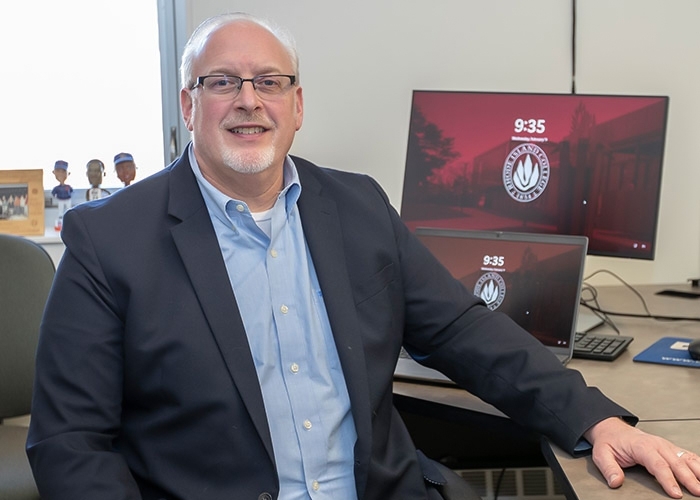
“This program has a good foundation,” he says. “One of the most appealing aspects of the sports management market is the variety of opportunities it holds. There’s something for everyone, from game day operations and ticket sales to becoming an athletic director or working in player personnel.”
Grabel says sports management students at RIC have an advantage because the program is aligned with the School of Business.
“Across the country, it’s less common for sports management to be housed under business schools,” he says. “However, the field is all about business, and the sports organizations hiring our students want future employees with business-based acumen.”
Raimondo says Grabel is working to ensure that the sports management curriculum keeps up with industry trends.
“First-year majors shadow sports managers, and in their last year, students do a 40-hour-a-week internship,” she says. “Some students are interning with high schools, others with college and professional teams. Whatever it takes, they’re getting exposure to the industry.”
Grabel’s career spans more than 25 years building collegiate sports management programs, including at Southern Connecticut State University and Post University, also in Connecticut. He says the field is extremely competitive.
“To be successful and stand out, students should be passionate, embrace volunteerism, engage in practicum and internship opportunities and focus on networking,” he says.
Those qualities are also vital for students seeking careers in cybersecurity, one of the fastest growing majors on campus.
Cybersecurity and AI
Douglas Alexander, director of the Institute for Cybersecurity and Emerging Technologies, says the growth of interest in the institute and the major isn’t surprising but validating.

The institute, which opened in 2024, is poised to become a national center of excellence in cybersecurity, artificial intelligence (AI), machine learning and other emerging technologies.
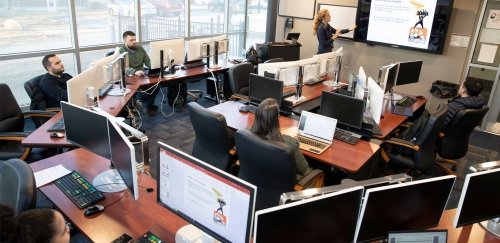
Alexander says he’s pleased that the institute’s new cyber range in Alger Hall, along with training and certification programs, are helping to boost enrollment in computer science, cybersecurity and AI at RIC. More than 400 students are enrolled in those programs.
“One of the institute’s core missions is to work with the Department of Computer Science and Information Systems to attract talented students, support them with hands-on experience and industry certifications and connect them to internships and careers,” he says.


The institute has also become a resource for the greater Rhode Island community.
“We’ve hosted several well-attended professional meetups, delivered free cybersecurity courses to working adults, supported high school interns through PrepRI and provided in-person cybersecurity and AI training for K-12 teachers,” Alexander says, noting that much of this activity has taken place in the cyber range at RIC.
“It’s only the third IBM-powered academic cyber range in the country,” he says, “making RIC a leader among the nation’s higher education institutions that are using this technology.” The range gives students simulated experiences of real-world cyberattacks and teaches them how to respond to them.
After voter approval of a 2024 bond referendum, Whipple Hall will soon undergo a $73 million overhaul, becoming the new home for the institute. It’s expected to open in 2028.
Alexander says the reconstructed hall, one of the “Original Six” buildings on campus, will feature 40,000 square feet of multi-purpose event space, another cyber range, a security operations center and several programmatic areas designed to be adaptable as new technologies emerge.
The new Whipple facility will help the institute fulfill one of its chief priorities: workforce development, says Alexander.
“The building will significantly expand our ability to offer evening, weekend and hybrid programs for working adults while also strengthening partnerships with libraries, community centers and regional organizations,” he says. “As our capacity grows and our partnerships expand, we plan to take on a larger role in bring cybersecurity, AI and digital skills training directly into communities across Rhode Island.”
“This will be a state-of-the-art space for Rhode Island,” Raimondo says. “I believe it will be a big draw for prospective RIC students because the building will feature small collaborative spaces that the School of Business doesn’t currently have,” she says. “This will allow for more opportunities for students to work in teams. There will also be a maker space [a collaborative, shared work space] for companies to use, complete with robotics, 3-D printing and other types of tech.”
Alexander adds that “the scale of student interest, combined with our expanding K-12 outreach and workforce development efforts, makes the need for the new building very clear.”
Elevating Student Support and Professional Skills
One of Raimondo’s key initiatives was to bolster student support by adding an all-day advisement activity each semester, a Business 100 course in professional etiquette for freshmen and ancillary programs, such as “Monday Mingles” and “Tuesday Tangos” – events designed to bring in business leaders to connect with students about internship pathways and workforce needs.
“The all-day advising was important to me because I saw frustration among students, who tend to wait until the last minute to seek advisors and then can’t get the classes they need,” she says. “It’s important for students to get good, on-time advising so they can stay enrolled and not delay graduation.”
Through the Business 100 course, students learn about the finer points of business etiquette and begin to develop technical and professional skills so that they will be prepared for the business world.
“Students need to know how to speak on the phone, how to be punctual and how to deliver presentations,” says Raimondo. “Business 100 addresses any gaps in those professional skills.”
To provide further support for students, Raimondo hired Joyce Perry to become the school’s academic coach. Perry was formerly a faculty member in RIC’s Department of Computer Science and Information Systems and also worked with students who have disabilities and are struggling in college.

“I often joke that I am a one-stop shop for student questions – whether they need help with financial aid, tutoring, time management or navigating resources across campus,” says Perry. “I may not always have the answer immediately, but students know I will find it for them and follow up.”
Perry also partners with faculty to solve student concerns.
“Faculty use me as a resource for support,” she says. “That could mean addressing attendance issues, connecting a student to academic services or stepping in to help a student who seems overwhelmed.”
She says, increasingly, upper-class students who she encountered as freshmen are reaching back to her for advice or guidance.
“That sustained connection was precisely the model we hoped to build, and it’s working,” she says. “By providing consistent, approachable and personalized support, my role as an academic coach has helped foster a sense of belonging and contributed to the retention and overall success of our business majors.”
Open for Business
As director of business programs, Perry has been instrumental in assisting Raimondo in forming partnerships between the school and 150 companies, such as Polaris MEP, Citizens Bank and AAA Northeast.

“We partnered with AAA Northeast to start a new course, titled Risk and Reward: Mastering Insurance and Sales,” Raimondo says, “because they expressed a need for more licensed insurance agents. After taking the course, students sit for the licensing exam, and, if they fare well, AAA guarantees them an internship.”
Six RIC business students took the exam last semester, and all passed.
Keri Borba, vice president of organizational development and human resources for AAA Northeast, says the need for insurance professionals is strong.
“Insurance touches nearly every aspect of daily life, from homes and vehicles to financial security, which means demand remains steady even during periods of economic change,” she says. “For students, insurance offers a career that is often surprisingly dynamic. It’s not only stable but also diverse in terms of roles, specialties and advancement paths.”
Borba notes that the internship partnership was intentionally created with an “intern-to-hire” goal.
“Students who engage fully, who take initiative and demonstrate a commitment to learning significantly strengthen their prospects of continuing their careers with us after graduation,” she says.
Other partnerships established by Raimondo and Perry include a collaboration with Skills for Rhode Island’s Future, which enabled 13 School of Business students to receive $20,000 stipends by working with members of the Rhode Island Small Business Hub. Another partnership with Polaris involved securing a federal grant to train students to do manufacturing assessments.
“Students assessed manufacturers in three areas: cybersecurity, operations and risk management,” Raimondo says. “They worked in teams, produced analyses to present to company executives and were paid $50 an hour. Hundreds of our students went through that program and gained real-world skills and a connection to Rhode Island’s businesses.”
The School of Business has also recently forged agreements with Care New England (CNE) and Citizens Bank.
Designed to strengthen the state’s healthcare technology workforce and accelerate innovation, the school has linked with CNE to develop a comprehensive healthcare technology workforce center. Its aim is to create a pipeline of skilled professionals in cybersecurity, AI, data analytics and digital health. CNE will enhance RIC-specific programs and design new clinical and healthcare management degree programs, professional certifications and workshops.
Additionally, RIC’s Institute for Cybersecurity and Emerging Technologies linked with CCRI to announce a partnership with Citizens Financial Group and Building Futures to create a first-of-its-kind registered apprenticeship program in the state for cybersecurity students. The pilot program, funded with a grant from the State of Rhode Island Governor’s Workforce Board, will see at least five students serve as apprentices at Citizens for a year, earning a competitive wage. The goal is to provide apprentices with the skills and experience they need to connect with career opportunities while in school and then contribute to Rhode Island’s tech economy after graduation.
At the end of the day, Raimondo says these collaborations achieve the School of Business’ top goal: “College degrees should lead to students building a livelihood for themselves and their families. Connecting them to businesses provides an opportunity to do just that.”
Farewell
The School of Business’ growth is a testament to Raimondo’s leadership and vision, says RIC President Jack Warner.
“From adding new, in-demand majors like A.I. and sports management, to launching the Institute for Cybersecurity and Emerging Technologies, to creating new networking and mentoring connections between students, alumni and businesses, the School of Business has flourished during Dean Raimondo’s tenure,” he says. “Her presence will be missed on campus, but we don’t see this as losing a member of our team – rather, we are gaining a valuable partner who can foster greater collaboration and coordination between RIC and CCRI, which will benefit students of both institutions.”
Susan Weiss ’88, an accounting professor in the School of Business since 2015, will serve as interim dean for the remainder of the semester while the search for a new dean gets underway.

“I am excited to continue the legacy and momentum that Dean Raimondo expertly built during her tenure,” Weiss says. “As a School of Business alum myself, I am proud to serve my alma mater in this capacity. The great interest in and support for our programs from students and stakeholders is evident as we move forward, continuing to innovate and grow. Our faculty and staff provide innovative learning experiences to support students in the achievement of their academic goals, and I am confident in the future success of our school, its students and alumni.”
Learn more about RIC’s School of Business.