
Why Choose EEP?
- Earn college credits while in high school
- Take college-level courses
- Save money on future college tuition
- Learn at your own high school
- Build academic confidence before starting college


The Early Enrollment Program (EEP) gives select, motivated high school students the opportunity to earn both high school and Rhode Island College credit for designated courses taught at their high school. It's a great way to experience college-level academics while staying in a familiar and supportive learning environment.
EEP is designed for motivated high school students who have demonstrated strong academic performance. Participation requires recommendations from teachers and school counselors and is available through participating high schools.

Everything you need to know about EEP:
Help your students earn college credit while they're still in high school. Partner with the EEP to expand academic opportunities and prepare students for college success. Learn how your school can participate and contact us with any questions.

Dual Enrollment courses allow high school students to earn both high school graduation requirement credits and Rhode Island College credits. Dual Enrollment courses are part of the college’s regular schedule and are taught at RIC by RIC faculty.
Participating high schools offer select courses that are approved by Rhode Island College and taught by qualified high school teachers. These courses follow the same academic standards as comparable RIC courses.
Students who enroll in EEP pay a reduced tuition rate for each course. Students attending Rhode Island public high schools may qualify for free tuition through the Prepare RI initiative.
When you successfully complete an EEP course, you'll earn both high school credit and Rhode Island College credit. Your college credits will appear on an official RIC transcript and may transfer to many other colleges and universities.
Unlike some programs, your college credit is based on the work you complete throughout the course—not a single end-of-course exam. Some high schools also offer combined EEP/AP courses, giving you the opportunity to earn college credit through your coursework while preparing for the AP exam.
The Early Enrollment Program gives you the opportunity to challenge yourself academically, earn college credit, and save money on your college education—all while staying at your high school.
EEP helps you prepare for college by taking real college-level courses in a familiar, supportive environment. You'll:
EEP can help you reduce the cost of earning your college degree.
Enrolling in an EEP course at your high school doesn't automatically earn you college credit.
To receive Rhode Island College credit, you'll need to complete the EEP registration process by the published deadline.
Once you're registered:
This table shows how EEP courses apply at Rhode Island College. All EEP credits count toward graduation, and nearly 90% of EEP courses satisfy a General Education requirement or count toward a major or minor. Many other colleges and universities also accept EEP credits, although transfer policies vary by institution.
| Course Number and Name | Type of Course/Requirements | Course Description |
|---|---|---|
| ACCT 201 Principles of Accounting I: Financial | Requirement in all majors in the School of Business | The identification, measurement, and reporting of the financial effects of economic events on enterprises are examined. 3 cr. |
| AFRI 200 Introduction to Africana Studies | RIC Social & Behavioral Science Gen Ed | This is a transdisciplinary of key issues in life and history of people of African descent and their interaction with other peoples and world cultures. 4 cr. |
| ART 201 Introduction to Visual Arts | RIC Visual and Performing Arts Gen Ed | Introduction to art-making, art vocabulary, and art history. Students work in a studio environment, producing and critiquing works while studying the arts within the context of history and society. For non-art majors only. Studio and lecture. 3 cr. |
| BIOL 111 Introductory Biology I | RIC Natural Science Gen Ed; requirement in some majors | Emphasis is on the molecular and cellular nature of living systems. This course is intended for science majors and any student with an interest in science. 4 cr. |
| BIOL 112 Introductory Biology II | RIC Natural Science Gen Ed; requirement in some majors; pre-requisite: BIOL 111 with a minimum grade of C- | Emphasis is on organismal and ecological levels of organization. This course is intended for science majors and any student with an interest in science. 4 cr. |
| CHEM 103 General Chemistry I | RIC Natural Science Gen Ed; requirement in some majors | Topics include atomic theory, periodicity, bonding, reactions, stiochiometry, gas laws, and thermochemistry. Laboratory experiments illustrate these concepts and develop laboratory techniques. 4 cr. |
| CHEM 104 General Chemistry II | RIC Advanced Quantitative & Scientific Reasoning (AQSR) Gen Ed; requirement in some majors. Pre-requisite: CHEM 103 with a minimum grade of C- | Topics include states of matter, solutions, kinetics, acids and bases, equilibrium theory, thermodynamics, and electrochemistry. 4 cr. |
| COL 125 College Learning Strategies | Counts as elective credit | Skills necessary for success in college are developed, with emphasis on organizational methods, study skills, and the interpretation of reading materials. Normally open to freshman and sophomore students only, with consent of instructor. 3 cr. |
| ECON 200 Introduction to Economics | RIC Social & Behavioral Sciences Gen Ed | This course fosters an understanding of the market economy and contemporary economic problems, such as economic growth and inflation, unemployment, income distribution, and the role of the government. Students cannot receive credit for Economics 200 if they have successfully completed or are currently enrolled in Economics 214. 4 cr. |
| ECON 214 Principles of Microeconomics | Requirement in all majors in the School of Business | Microeconomics is introduced, including such areas of decision making as individual demand theory, cost theory, production theory, and the structure of markets. 3 cr. |
| ECON 215 Principles of Macroeconomics | Requirement in all majors in the School of Business (except Health Care Administration) | The U.S. economy as a whole is considered and problems of inflation and recession are explored by examining aggregate demand, aggregate supply, national product and income, and the influence of money and interest rates on the economy. 3 cr. |
| ENGL 113 Approaches to Drama | RIC Arts Gen Ed | Drama as an art form is studied through the reading, viewing and analysis of selected plays, past and present. 4 cr. |
| ENGL 118 Introduction to the Literary Experience | RIC Literature Gen Ed | This course provides students with a rich experience of literature from a variety of periods and genres, exploring the questions of what literature is and how texts make meaning. 4 cr. |
| FIN 230 Personal Finance | Counts as elective credit | Students examine the markets and institutions they will deal with throughout their financial lives. Topics include borrowing money, real estate, banking, insurance, investing, and retirement planning. 3 cr. |
| FNED 101 Introduction to Teaching and Learning | Requirement in teacher education programs | Students construct a map for their journey of developing a professional educator identity. Students explore essential questions of social justice education through academic and field experiences. 2 cr. Graded S, U. |
| FREN 113 Intermediate French I | Meets Lit and Lang category for Gen. Ed. Requirement for minor in French. | The cultural heritage of the French-speaking world is examined through selected cultural readings. Grammar and vocabulary are reviewed through a communicative approach. 4 cr. |
| FREN 115 Literature of the French-Speaking World | Meets Lit and Lang category for Gen. Ed. | Students are introduced to techniques of literary analysis through readings from France and the Francophone World as they continue to develop speaking, reading, and writing skills in French. 4 cr. |
| HPE 115 Fundamentals of First Aid & CPR | Counts in coaching minor | Fundamental principles and skills of basic first aid and cardiopulmonary resuscitation (CPR) are presented. Upon satisfactory completion of each unit, appropriate certification is available. 1 cr. |
| HPE 201 Prevention & Care of Athletic Injuries | Counts in coaching minor | Students acquire a basic understanding of sports medicine. Topics include preventive techniques, protective strapping, basic anatomy, injury recognition, and rehabilitation of athletic injuries. 3 cr. |
| HIST 117 Introduction to Historical Analysis | RIC History Gen Ed | This course introduces students to historical themes within a particular era or period such as European history, Western civilization, or the Holocaust. 3 cr. |
| HIST 118 U.S. History I | RIC History Gen Ed | This course provides an in-depth study of the history of the United States up to 1877 through five strands of history: political, economic, religious, social, and intellectual. 3 cr. |
| HIST 119 U.S. History II | RIC History Gen Ed | This course provides an in-depth study of the history of the United States from 1877 to the present through five strands of history: political, economic, religious, social, and intellectual. 3 cr. |
| ITAL 113 Intermediate Italian I | Meets Lit and Lang category for Gen. Ed. Requirement for minor in Italian. | The cultural and linguistic heritage of Italy is examined through selected readings. Grammar is reviewed and basic oral and written skills developed. 4 cr. |
| ITAL 115 Literature of Italy | Meets Lit and Lang category for Gen. Ed. | Students are introduced to techniques of literary analysis through readings from various periods of Italian literature as they continue to develop speaking, reading, and writing skills in Italian. 4 cr. |
| MATH 240 Statistical Methods I | RIC Gen Ed Math; requirement in some majors. Prerequisite: C+ or better in Algebra II | Descriptive statistics; confidence intervals and hypothesis testing; random variables; estimations and tests of significance; and correlation and regression are studied. Students cannot receive credit for both MATH 240 and MATH 248. 4cr. |
| MEDI 201 Orientation to Medical Imaging | Requirement in a major | Topics include the history of x-rays, the technologist's role on the health care team, radiographic equipment, clinical settings and the various modalities in diagnostic imaging (formerly RADT 201). 1 cr. |
| MEDI 255 Patient Care in Medical Imaging | Requirement in a major | Students will learn the patient care skills needed for safe practice in the healthcare environment. 3 cr. |
| MGT 100 Introduction to Business | Counts as elective credit | Business concepts are introduced and the practices of management in both the business sector and non-profit organizations. Topics focus on all the management disciplines. 3 cr. |
| MUS 207 Electronic Music | Counts in digital media production minor (formerly MUS 117 3 cr.) | This studio course is designed for students with little or no experience I electronic music. Students become familiar with the basic components of the electronic lab and create electronic compositions. 4 cr. |
| MUS 220 Advanced Digital Audio Production I | Counts in digital media production minor | This course is designed for students interested in live and studio audio production in a computer-based studio. Students cannot receive credit for COMM 220 and MUS 220. 4 cr. |
| MUS 201 Survey of Music | RIC Visual & Performing Arts Gen Ed | Musical eras, styles, forms, and basic vocabulary are introduced to the non-music major through music literature. An ability to read music is not presumed. 4 cr. |
| MUS 203 Elementary Music Theory | RIC Visual & Performing Arts Gen Ed | Fundamentals of scale construction, intervals, syllables, clefs, rhythms, and form are studied, with emphasis on musical acuteness through ear training, sight singing, and diction. 4 cr. |
| MUS 223 American Popular Music | RIC Visual & Performing Arts Gen Ed | The growth of popular music in the United States is surveyed from its historical background. 4 cr. |
| MUS 225 History of Jazz | RIC Visual & Performing Arts Gen Ed. Counts in Jazz Studies minor | Jazz styles, forms and basic vocabulary are introduced to the non-music major through music literature and sound. Listening outlines will be created and used to help develop skills. 4 cr. |
| POL 102 American Government | RIC Social & Behavioral Sciences Gen Ed | The institutions and principles of American national government are examined. Topics include the constitutional foundation, federalism, political parties, Congress, the presidency, the Supreme Court, and civil rights. 4 cr. |
| POL 204 Introduction to Political Thought | RIC Social & Behavioral Sciences Gen Ed; requirement in some majors | Fundamental concepts and issues of philosophy and political theory are investigated. Basic precepts about authority, law, government, and the terms of obligation are examined in light of contemporary concerns. 4 cr. |
| PORT 113 Intermediate Portuguese I | Meets Lit and Lang category for Gen. Ed. Requirement for minor in Portuguese. | The cultural and linguistic heritage of the Portuguese-speaking world is examined through selected readings. Grammar is reviewed and basic oral and written skills developed. 4 cr. |
| PORT 114 Intermediate Portuguese II | Meets Lit and Lang category for Gen. Ed. Requirement for minor in Portuguese. | Students develop both reading skills and an appreciation of literature as a reflection of the heritage of the Portuguese speaking world. Development of oral skills continues and attention is given to written practice. 4 cr. |
| SPAN 113 Intermediate Spanish I | Meets Lit and Lang category for Gen. Ed. Requirement for minor in Spanish. | The cultural and linguistic heritage of The Spanish-speaking world is examined, while grammar is reviewed and basic oral and written skills are developed. 4 cr. |
| SPAN 115 Literature of the Spanish-Speaking World | Meets Lit and Lang category for Gen. Ed. | Students are introduced to techniques of literary analysis through readings from Spain and Latin America as they continue to develop speaking, reading, and writing skills in Spanish. 4 cr. |
| TECH 216 Computer-Aided Design | Required in a major | International drafting-language protocol is explored and used in solving design problems in orthographic and pictorial presentation. Study includes basic computer-aided drafting. 3 cr. |
| TECH 327 Construction Systems | Required in a major | This course is an introduction to the skills, knowledge, environments, and people of the construction industry. A laboratory component is required for students to plan, design, and build a structure. 3 cr. |
The college credits you earn through EEP become part of your official Rhode Island College transcript. If you attend RIC, your credits count toward graduation. If you choose another college or university, many schools across the country also accept EEP credits.
Because every college has its own transfer credit policy, it's important to check with the schools you're considering. Most colleges require a grade of C or higher to transfer credit, although some may have different requirements.
When you apply to college, be sure to request an official Rhode Island College transcript so your EEP credits can be evaluated for transfer.
EEP credits have been accepted by hundreds of colleges and universities across the United States, including many well-known public and private institutions.
** Does not accept math courses
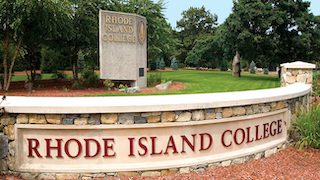
The Early Enrollment Program is housed in the Forman Center, Room 200, on the Rhode Island College Campus.