
High-Demand Chemistry Careers
- Chemist
- Chemical Engineer
- Toxicologist
- Forensic Scientist
- Pharmacologist
- Materials Scientist
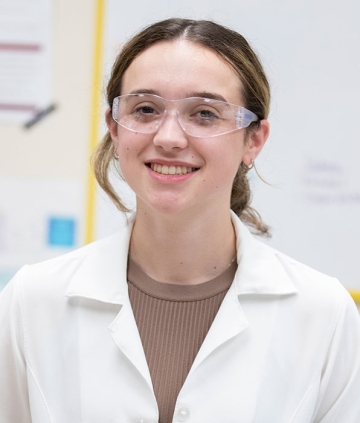
Our program builds a comprehensive foundation in all areas of the discipline, offering multiple degree and concentration options. With 7,800 job openings projected each year over the next decade, chemistry is a crucial area of need in a variety of industries. Make a smart choice with a Bachelor of Arts or Bachelor of Science in Chemistry from RIC.
One Day Only! Join students from across Rhode Island on November 16 and apply free to Rhode Island College! Take advantage of Apply to RIC for Free Day and we'll waive your $50 application fee.
On November 7, from 12:30–4 pm, come see all that RIC has to offer. Discover how we prepare students for success through in-demand academic programs, hands-on learning and state-of-the-art facilities.
We're thrilled that you're interested in Rhode Island College and we want to make sure that nothing stands in your way of pursuing a RIC degree. Just let us know how we can help you with your next steps.
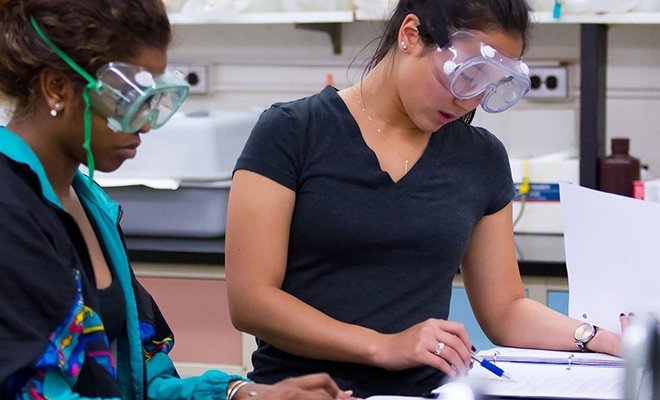
Understand the courses you’ll take, the curriculum requirements to meet, and the concepts you’ll gain mastery of. This program also offers 2 concentrations and a minor program option. Get the detailed information you’re looking for.
Clarke Science, home of our chemistry program, just underwent a $60 million renovation. The modern research and teaching workspace now houses 10 teaching labs, 4 research labs, an instrument room, 2 lecture halls, 2 traditional classrooms, and faculty offices.







“Dr. Knowlton is by far one of the most important influences in my life. I owe her a lot. In fact, I owe the entire department a lot. They were all fantastic teachers. I never expected to be so much further ahead in grad school compared to my peers, yet there I was sitting in class thinking, ‘I know this material already.’ I already learned it at RIC.”

You don't have to be a total science geek to appreciate what goes on in the Department of Physical Sciences at Rhode Island College.
In your degree plan, you will choose between a BA in chemistry or BS in chemistry.
The Chemistry Bachelor of Arts degree program is less specialized and more versatile than the BS program and includes more electives. You may consider courses in management, biology, physics and computer science. Many BA majors choose to minor in biology, math or physics in preparation for careers in chemistry and other technology and biotechnology industries. When combined with biology electives, this program is an ideal basic preparation for careers in medicine, dentistry or environmental science. Although it is not required, some independent study or other research participation is highly recommended, and many faculty research projects are open to student participation within the department.
The Chemistry Bachelor of Science degree program offers two American Chemical Society (ACS)-certified concentrations: Biochemistry and Professional Chemistry. These concentrations require at least 3 credits of research with a faculty member in the department.
The ACS-certified BS in chemistry with biochemistry concentration provides a solid foundation in the five areas of chemistry (organic, inorganic, analytical, physical and biochemistry), while providing hands-on biochemistry laboratory experience. This concentration requires you to complete an intensive 3 credit hour laboratory course as well as 3 credit hours of independent study (research). Several faculty research projects are currently underway for you to choose from. You may also choose to complete an honors thesis. Electives in computer science, mathematics and physics are recommended.
The ACS-certified BS in chemistry with professional chemistry concentration will prepare you for careers in industry, government or academia. This degree is also excellent preparation for entrance into a PHD program. At least 3 credit hours of independent study (research) is required. Several faculty research projects are currently underway for you to choose from. You may also choose to complete an honors thesis. Electives in biology, computer science and physics are highly recommended.
Upon completion of this program, students will be able to demonstrate:
Declaring a minor allows you to explore other areas of interest and make interdisciplinary connections. Minor areas at RIC complement and reinforce all major areas of study. By declaring a minor, you can set yourself apart as a candidate for job, internship and volunteer opportunities.
The Department of Physical Sciences covers the four main branches of physical science: physics, chemistry, Earth science and space science.